The Timeless Elegance of Hydrangeas and Roses
Picture the moment you walk into a room and a cloud of pale-blue hydrangeas framed by buttery ivory roses stops you mid-sip of your welcome-drink. That, dear reader, is the horticultural equivalent of a string quartet striking up Vivaldi—effortless, old-world sophistication with just enough modern freshness to keep things interesting. Hydrangeas bring billowy volume and a watercolor softness; roses add architectural swirl and that irresistible “someone loves me” aroma. Together they’re Fred and Ginger: each brilliant alone, pure magic when they dance.
In the next few minutes you’ll learn why these two classics pair like champagne and oysters, how to keep them alive long enough to impress even your judgiest aunt, and the sneaky design tricks florists use to make grocery-store blooms look like they came from a Parisian atelier. Grab your clippers and a sense of adventure—elegance is about to become democratic.
Essential Techniques for Combining Hydrangeas & Roses
First, the backstage prep that determines whether your arrangement survives past the group-chat photos. Hydrangeas are drama queens: cut them, they seal their stems faster than you can say “Instagram story,” then act shocked when they wilt. Slice stems at a 45° angle, immediately plunge them into a bucket of lukewarm water up to their necks, and—this is the spa secret—float a few ice cubes on top for five minutes. The cold shock closes the stomata, slowing respiration like a botanical meditation retreat.
Roses, meanwhile, arrive armored with thorns and outer petals that look like they partied too hard. Strip foliage that would sit below the waterline (bacteria salad, anyone?), remove the guard petals—those slightly green outer ones—to reveal pristine blooms, and give each stem a fresh underwater cut to prevent air embolisms. Think of it as angioplasty for flowers.
When you marry the two, remember the “lawn chair rule”: hydrangeas are the wide seat that sets the silhouette; roses are the colorful cushions that draw the eye. Place hydrangeas first to create the skeletal shape, then tuck roses so their heads sit just above the hydrangea plane—close enough to mingle, far enough to avoid crowding that causes petal bruising.
Popular Hydrangea & Rose Arrangement Formulas
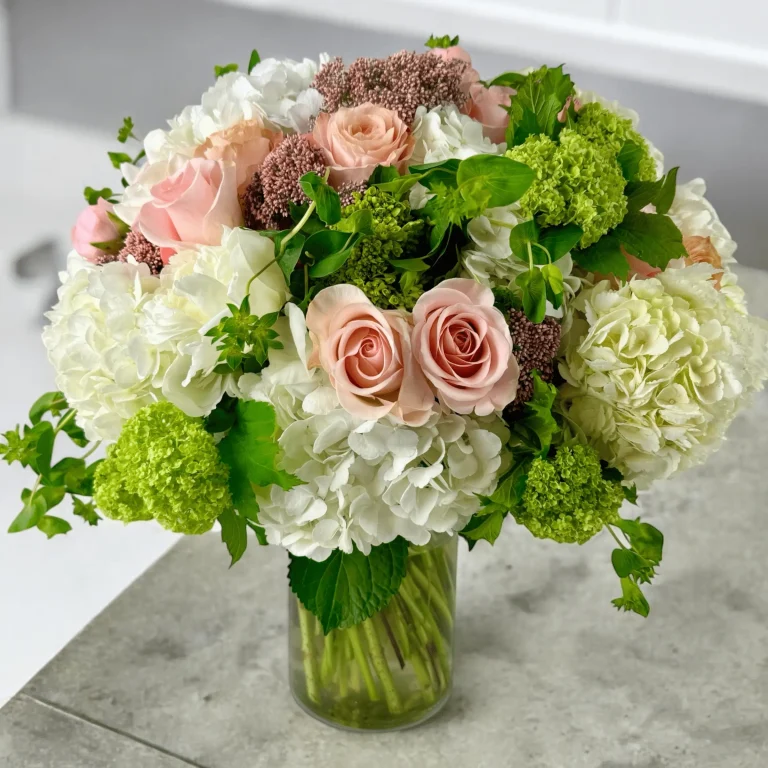
Color is emotion in visible form. For instant black-tie vibes, pair white ‘Annabelle’ hydrangeas with ivory ‘Avalanche’ roses and a whisper of sage ruscus. The palette whispers rather than shouts, letting texture do the talking—velvet rose edges against matte hydrangea sepals.
Feeling bolder? Try analogous romance: lavender hydrangeas, blush roses, and a flirt of mauve sweet pea. Analogous colors sit next to each other on the color wheel, so the eye glides across the bouquet like a skater on smooth ice. Complementary drama arrives when you place apricot roses against sky-blue hydrangeas—opposites on the wheel, sparks flying, yet balanced by the shared softness of both blooms.
Proportion-wise, aim for 60 % hydrangea mass, 30 % roses, 10 % textural accents. Hydrangeas give you the “wow, that’s full” without bankrupting you; roses supply the “someone actually designed this.” It’s the floral version of a great haircut—volume plus strategic highlights.
Stylish Arrangement Forms & Structures
Low centerpiece or towering show-stopper? For dinner parties, keep things below chin-level so guests can debate politics unimpeded. Use a wide-footed compote, anchor a dry ball of chicken wire inside (eco-friendly, reusable), and let hydrangeas skim the rim like cumulus clouds. Insert roses in triangular clusters—three, five, seven; odd numbers please the eye—so every glance lands on a rose, never a bare patch.
Tall arrangements scream “I have a cathedral ceiling and I’m not afraid to use it.” Opt for a slender column vase, lock hydrangeas into a floral foam cage at the top, and let roses spiral downward on clear plastic stakes. The negative space between blooms and table creates breathing room; the overall effect is a floral chandelier.
Hand-tied bouquets? Think British royal wedding: hydrangeas form the domed base, roses angle slightly outward to avoid the dreaded “ice-cream cone” silhouette. Bind with raw silk ribbon that matches your smallest rose—details matter when the Queen might photobomb.
Elevating Elegance: Color, Texture & Foliage
Foliage is the bassline; without it the melody feels thin. Seeded eucalyptus offers silvery coin-shaped leaves that bounce light into shadowy bouquet centers. Israeli ruscus has the rigidity of a Broadway dancer, allowing you to create internal scaffolding so stems don’t slump. For Mediterranean chic, olive branches bring a muted sage tone and that coveted “I summer in Santorini” energy.
Texture play keeps monochromatic schemes from flat-lining. Add quicksand roses—buff tones with a papery edge—against snow-white hydrangeas. The subtle color shift is like switching from matte to satin lipstick: same color family, entirely new mood. Hypericum berries or blush astilbe can act as jewelry, but limit to one accent type; too many extras and the arrangement starts to look like it raided Grandma’s costume box.
Choosing the Perfect Vessel for Elegant Designs
Vessel choice is 50 % of the stylistic battle. A clear glass cylinder is the little black dress—appropriate almost anywhere—but line the interior with a collar of tropical leaves to hide murky water and add graphic punch. Matte-white ceramic vessels modernize pastel blooms; black marble cubes make pale flowers levitate. For garden-party whimsy, vintage teapots or silver mint-julep cups provide conversation starters—just insert a plastic liner to prevent leaks worthy of a British farce.
Size math: the vessel should be roughly one-third the height of the total arrangement. Any taller and you risk “toilet-brush” proportions; shorter and the bouquet looks like it’s melting. When in doubt, err on the side of wider rather than taller—hydrangeas need elbow room.
Elegant Styles & Themed Inspirations
Romantic Garden: imagine the last scene in a Jane Austen film—loose, airy, stems apparently “just gathered.” Use blush hydrangeas, garden roses, and let spiraea foliage drape like unruly curls. Secure with a velvet ribbon that trails 18 inches; instant Regencycore.
Modern Minimalist: one hydrangea head submerged in a tall cylinder, a single rose floating above it on a monofilament line. The negative space is the star; color palette limited to white and one metallic accent. It’s the bouquet equivalent of a Haiku—17 syllables of perfection.
Vintage Chic: pair antique cream hydrangeas with butter-yellow ‘Patience’ roses in a tarnished silver compote. Tuck in a few dried lavender sprigs for fragrance; the overall vibe is “I inherited this from Great-Aunt Sybil who once danced with Hemingway.”
Event-specific twist: for winter weddings, paint dried hydrangea heads with a whisper of metallic acrylic and pair with deep-red ‘Freedom’ roses. The frosted texture reads holiday without veering into mall-Santa territory.
Pro Tips for Long-Lasting Elegance
Hydrangeas hate two things: heat and air conditioning. Display them away from HVAC vents and fruit bowls (ethylene gas is the silent assassin). Mist the blooms daily; their petals can absorb water like skin drinks serum. For roses, re-cut stems every two days under running water and add a drop of bleach to the vase—think of it as a tiny swimming-pool maintenance crew.
Floral food ratio: one packet per pint of lukewarm water. Too much sugar ferments, turning your vessel into Prohibition-era bathtub gin. If you run out, DIY with 1 teaspoon sugar, two drops bleach, and a coin’s worth of lemon juice—basically a Tom Collins minus the fun.
Display rotation: every 24 hours, spin the arrangement 180° so gravity doesn’t bully one side into a floral comb-over. Your flowers will thank you with an extra three days of swagger.
Step-by-Step Tutorial: A Sample Elegant Centerpiece
Let’s build the “Cloud Nine” low centerpiece you can plonk on a Sunday brunch table and bask in compliments until the mimosas run dry.
Supplies: 5 white hydrangea stems, 7 quicksand garden roses, 3 stems seeded eucalyptus, one roll of chicken wire, a low-footed compote (6 in tall, 8 in wide), floral food, and pruners.
Step 1: Activate the hydrangeas with the ice-bucket trick described earlier. While they chill, fold chicken wire into a softball-sized orb and wedge into the compote; it should crunch loudly—that’s the sound of sustainability.
Step 2: Strip lower leaves from eucalyptus and insert at angles to create a airy collar that hides the wire. Think of it as eyeliner: subtle but transformative.
Step 3: Add hydrangeas, one at a12 o’clock, 6 o’clock, then 3 and 9. This cross-formation locks the structure. Heads should sit just above the rim—no wallflowers.
Step 4: Cluster roses in trios: one facing straight up, two angled outward like a relaxed peace sign. Keep rose heads ½ inch above hydrangea plane for dimensional pop.
Step 5: Fill any gaps with remaining eucalyptus tips, letting a few trail like casual handwriting. The final shape should look like a loose dome—controlled chaos, Bridgerton edition.
Step 6: Add water mixed with floral food until the compote is ¾ full. Place on a mirrored tray to double the visual volume; narcissistic flowers love company.
Expected lifespan: 5–7 days if you follow the maintenance cheat sheet. Post daily stories; your DMs will overflow like the vase.
Frequently Asked Questions (FAQ)
Can I use any type of hydrangea and rose together? Technically yes, but marriage counseling helps. Big-leaf hydrangeas (the color-shifting ones) pair best with romantic garden roses because their petal weights feel equal. Paniculatas—those cone-shaped show-offs—match better with spray roses for rustic vibes. Avoid mixing teeny patio roses with basketball-sized hydrangeas unless you want a David-and-Goliath tension.
How do I prevent roses from wilting faster than hydrangeas? Roses age in dog years; keep them cool and recut often. If one droops, float the whole stem in a bowl of warm water for 30 minutes—hydrotherapy for blooms.
What is the best way to achieve a “full” look elegantly? Resist the urge to stuff. Use hydrangeas as cloud banks, then let roses breathe. Negative space is the luxury real estate of floral design.
How far in advance can I make this type of arrangement? For weddings, 24–36 hours max. For Tuesday-night ego boosts, Sunday evening is fine; you’ll still have bragging rights by Wednesday.
Are there specific rose varieties that pair best with hydrangeas? Garden roses (’Peony-style’), spray roses for filler, and large-headed ‘Avalanche’ or ‘Escimo’ for monochrome magic. Avoid stark-red long-stem classics unless you’re shooting a 1980s power-ballad music video.
Resources and Further Inspiration
For science-backed flower care, the Society of American Florists offers free PDFs on hydration and ethylene sensitivity. University extensions like Minnesota Extension provide detailed post-harvest handling charts. When sourcing, seek domestic growers such as California Grown Flowers or European eco-certified farms via Florverde for sustainability cred. For visual rabbit holes, scroll the portfolios of Ariella Chezar or Emily Thompson—the Beyoncé and Bowie of botanical design.
Conclusion
Elegance isn’t a price tag; it’s a series of small, intentional choices—like letting hydrangeas pre-game in an ice bath or giving roses their own personal swimming pool. Combine cloud-like hydrangeas with swoon-worthy roses, balance color like a cinematographer, and remember that restraint reads as refinement. Now that you’ve got the cheat codes, raid the grocery store, commandeer the neighbor’s vintage teapot, and create a centerpiece that makes even your most Instagram-jaded friends double-tap in real life. After all, flowers fade, but the memory of effortless sophistication—like the faint scent of roses on a dinner napkin—lingers far longer.